
🐝 Propolis
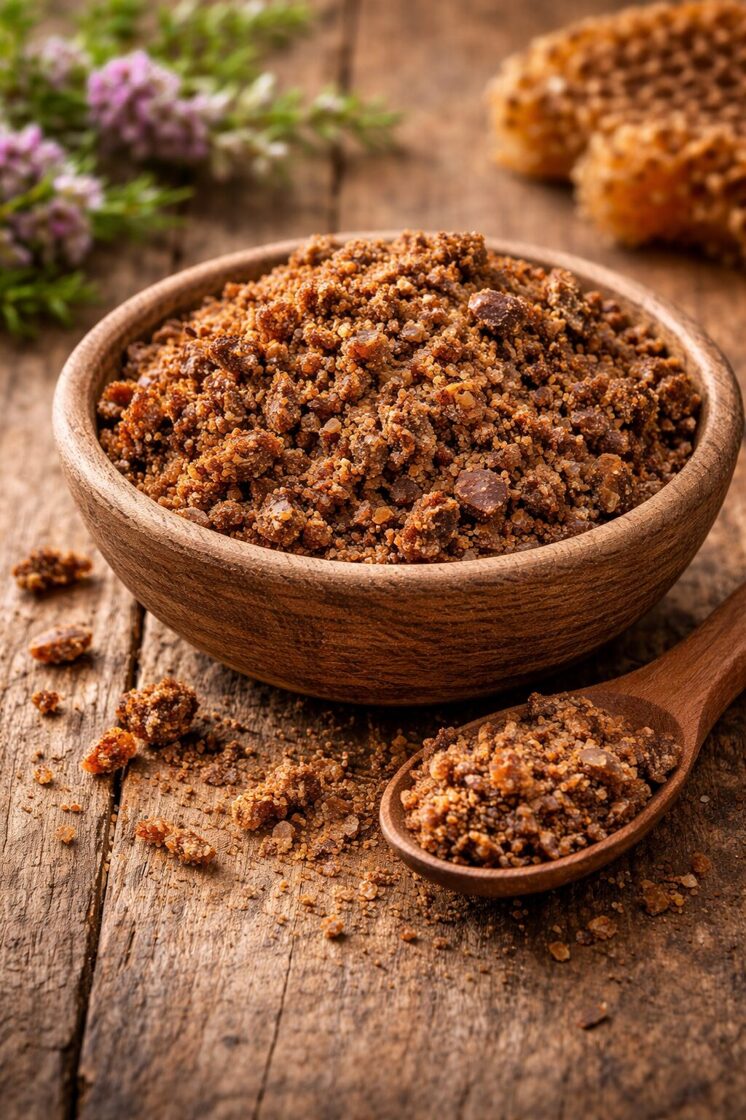
Propolis is collected by bees from plant buds and resinous substances found in flowers and trees.
The wide range of healing properties of propolis is mainly based on its antibacterial activity.
In traditional folk medicine, propolis is warmed and applied to linen cloth, or alternatively, propolis-coated hive cloths can be used. It has traditionally been used for the treatment of boils, slow-healing wounds, and burns, as well as for joint pain and nerve pain.
It is recommended to apply it overnight, wrapping the cloth with a bandage and covering it with knitted or woolen fabric.
Uses of Propolis in Medicine
Propolis can be used in different forms:
- propolis ointments, usually made with white or yellow petroleum jelly, lanolin, animal fats, or vegetable oils (such as olive oil, sunflower oil, etc.);
- propolis extracts in water or alcohol solutions of various concentrations;
- propolis pastes;
- propolis emulsions: propolis dissolved in 96% alcohol and mixed with water or milk;
- propolis plasters (used for skin conditions);
- crushed propolis for inhalation and biological dressings;
- chewing gums and candies, more commonly used in dentistry.
Propolis Ointment (Paste)
To prepare propolis ointment, the propolis is first cleaned of impurities and crushed in a mortar.
Petroleum jelly is placed in an enamel container and heated to 45°C (113°F).
The crushed propolis is then added and stirred until a smooth, uniform mass is formed.
After that, it is filtered through double-layered gauze, and the ointment is ready for external use.
Propolis Alcohol Solution
A propolis alcohol solution is prepared in different concentrations, most commonly 20–40%.
Preparation:
Pour 500 ml of 96% alcohol over 100 g of crushed propolis and shake for 30 minutes.
Store the mixture in a dark place, shaking it occasionally.
After 2–5 days, filter it through gauze.
This solution can be stored for many years and serves as a base preparation for making other propolis products.
Propolis for a Runny Nose
Many doctors believe that propolis preparations are among the few remedies that can effectively help treat a runny nose, a condition that often responds poorly to treatment.
As soon as the first symptoms of a runny nose appear, the nasal passages should be lubricated two or three times a day with 20% propolis oil or ointment.
A runny nose may disappear within a few days.
However, if propolis is started after heavy nasal discharge has already begun, the effect is usually much weaker.
⚠️ Important note
This information is based on traditional and folk uses of propolis.
It is not a substitute for professional medical advice.
People who are allergic to bee products should use propolis with caution or avoid it entirely.